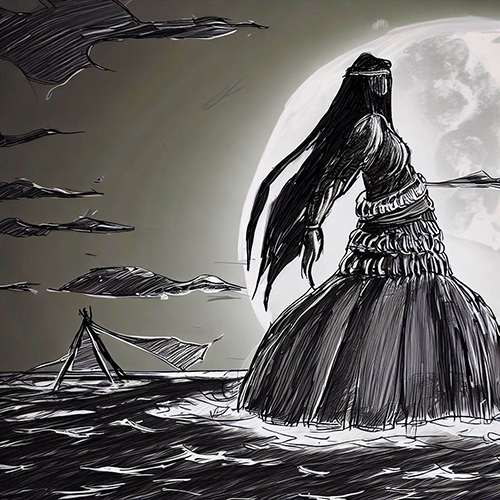
Dey Zangeroo : The Enchanting Sea Spectre in Bushehr Narratives
Within the rich cultural tapestry of Iran’s southern coasts, particularly in the port city of Bushehr, stories and legends have been passed down through generations, seemingly born from the tumultuous waves of the sea. Among these fascinating narratives is the tale of “Dey Zangeroo” a being that haunted the dreams of captains and sailors on moonless nights.
Bushehr, a city with a glorious history of seafaring and trade, has always been intertwined with the sea. The dhows and ships of this region, carrying cargo and passengers, embarked on long journeys across the azure waters of the Persian Gulf. However, at times, nature had other plans. There were days when the moon, the beacon of sailors’ nights, vanished from the sky, leaving vessels adrift in an endless, disoriented sea under absolute darkness.
On such nights, when the heavy silence of the sky gave way to anxiety, the people of Bushehr would also worry about their loved ones at sea. They would gather by the shore, gaze at the starless sky, and in sorrow for the disappeared moon, they would murmur a chant:
(“Dey Zangeroo” leave the moon, leave the full moon)
This chant was, in essence, a plea for the moon’s return and a ward against the lurking danger. But who was “Dey Zangeroo”? In folklore, “Dey Zangeroo” is described in two distinct ways
–The first narrative – portrays “Dey Zangeroo” as a towering, dark-faced woman whose head surpasses the height of the tallest dhows, with hair extending into the deepest parts of the sea. It was believed that she was the one who stole the moon
The second narrative – attributes a monstrous crab-like form to “Dey Zangeroo”, which abducts the moon with its large, crab-like claws
In both accounts, her objective is to seize dhows and their crews during the dark of night. It was believed that if the moon remained hidden and “Dey Zangeroo” could not be repelled by the locals or perhaps some other force, the dhow and its passengers would be hers, with only the remnants of their bodies washing ashore
This legend not only reflects the fear of the unknown sea and the darkness of the night but also signifies the deep connection of the Bushehri people to the sea, their respect for its power, and their efforts to protect their loved ones from potential dangers. “Dey Zangeroo” serves as a reminder of those moonlit and moonless nights, and the tales that arose from the heart of the sea and the longing for absent loved ones